
New Mexico MVD Permit Practice Test 28
- Questions25
- Correct to pass18
- Passing score72%
- Minimum age15 years
-
1. Why should you not rest your foot on the brake pedal as you drive?
Show answer
Answer D: The brake lights stay on and the drivers behind cannot read you
Resting on the pedal keeps the brake lights lit and wears the brakes, so following drivers stop believing your brake lights.
-
2. Your vehicle leaves the road and enters deep water. What gives you the best chance of escape?
Show answer
Answer B: Release your seat belt and get out through a window as quickly as possible
Water pressure holds the doors shut, so a window is the reliable exit and the first seconds after entry are the best time to use it.
-
3. You are driving in fog so thick that you can barely see the vehicle ahead. Which pavement marking is the best guide for staying in your lane?
Show answer
Answer A: The white edge line on the right side of the road
The right edge line keeps you positioned away from oncoming traffic and is easy to follow at low speed. Following tail lights closely tempts you to drive faster than you can see.
-
4. When must a returning New Mexico applicant retake both the written and road tests, even if they were once fully licensed?
Show answer
Answer D: Whenever their license has been expired, or they held no valid permit or license, for five years or more
New Mexico requires a new written and road test for anyone whose license lapsed, or who held no valid permit or license, for five years or more.
-
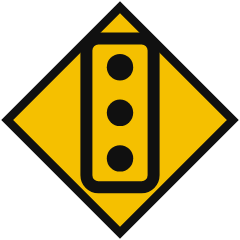
5. A driver passes this sign and the signal beyond it is already showing green. What is the safest response?
Show answer
Answer C: Ease off the accelerator and be ready to stop, because an indication that has been showing for a while is about to change
A signal that has been displaying the same indication for some time is close to changing, so arriving at a controlled speed with the brake covered is safer than accelerating to beat it.
-
6. You have stopped on an uphill grade close behind a large truck at a traffic signal. What is the risk?
Show answer
Answer B: The truck may roll back into you when it starts to move
Heavy vehicles can roll backward a short distance when the driver moves from the brake to the accelerator on a hill. Leave extra room when stopped behind a truck on a grade.
-
7. A pedestrian with a white cane draws the cane back and steps away from the curb as you approach. What does that usually mean?
Show answer
Answer B: They are signaling you to go ahead and drive on
Pulling the cane in and stepping back from the curb is the customary way a blind pedestrian tells drivers to proceed.
-
8. You are stopped at the yield line of a roundabout when an emergency vehicle comes up behind you with lights and siren. What should you do?
Show answer
Answer A: Stay out of the roundabout and pull over to the right of your lane if there is room
Never enter a roundabout ahead of an emergency vehicle and never stop inside one; wait clear of the entry so the crew can get through.
-
9. A small yellow plaque showing a speed number below a curve warning sign gives
Show answer
Answer C: the speed recommended for the condition being warned about
The advisory speed plaque belongs to the warning series and states the speed judged safe for the condition ahead under good circumstances, not a regulatory limit.
-
10. What is the minimum age for a New Mexico instructional permit?
Show answer
Answer B: 15 years old
New Mexico issues the instructional permit at 15, provided the teen is enrolled in or has completed an approved driver education program and passes the knowledge and vision tests.
-
11. What are the minimum liability coverage amounts required in New Mexico?
Show answer
Answer B: $25,000 per person, $50,000 per accident and $10,000 property damage
The New Mexico Mandatory Financial Responsibility Act sets minimums of 25,000 dollars for injury or death of one person, 50,000 dollars for two or more people and 10,000 dollars for property damage.
-
12. You are about to descend a long steep grade. How should you control your speed?
Show answer
Answer D: Select a lower gear before starting down and use the brakes in firm, brief applications
Engine braking in a lower gear carries most of the load down the grade, while continuous brake pressure overheats the brakes and reduces their effectiveness.
-
13. Another vehicle is passing you on a two-lane road. What should you do with your speed?
Show answer
Answer A: Hold your speed or ease off slightly to shorten the pass
Speeding up strands the passing driver in the oncoming lane, while a steady speed or a slight lift lets the pass finish quickly and safely.
-
14. On a narrow two-lane road a line of vehicles has built up behind you. What is the safe and courteous action?
Show answer
Answer D: Pull into a turnout or a safe wide spot and let them go by
A slow vehicle holding up a queue invites risky passing; using a turnout clears the road without anyone having to take a chance.
-
15. A sign at the signal reads LEFT TURN ON GREEN ARROW ONLY. The ball turns green but no arrow appears. What may you do?
Show answer
Answer C: Wait, because your turn is allowed only while the arrow is showing
The sign removes the permissive turn, so the left is legal only during the green arrow and you must wait behind the line until it appears.
-
16. A yellow diamond on an exit ramp shows a truck tipping over onto two wheels. Which drivers does it concern most?
Show answer
Answer D: Those in tall vehicles carrying a high load
The truck rollover sign warns that the curve can overturn a vehicle with a high center of gravity, so such drivers must slow well below the normal ramp speed.
-
17. You park a manual transmission car facing uphill at a curb. What is the correct combination?
Show answer
Answer A: First gear, wheels turned away from the curb, parking brake set
Facing uphill the car would roll back, so first gear resists that, the wheels turned out let a tire catch the curb, and the parking brake holds it.
-
18. You are entering an angle parking space on your right. What should you do?
Show answer
Answer C: Stay a little left of the space, then turn in between the lines
Keeping a little left of the space gives the front wheels the room to turn in cleanly and leaves your car centered between the lines.
-
19. What is the right speed for a normal right turn at a city corner?
Show answer
Answer C: Slow enough to hold your lane and stop for a pedestrian
A city right turn is tight and crosses a crosswalk, so the correct speed is one that keeps you inside your lane and still allows a stop.
-
20. Who must accompany a New Mexico applicant under 18 when applying for an instructional permit or a driver's license?
Show answer
Answer C: A parent, guardian, or other responsible adult
The MVD's licensing procedures require a minor applicant to be accompanied by a parent, guardian, or other responsible adult.
-
21. A city transit bus ahead of you has stopped at the curb with its passenger door open. What does the law require of you?
Show answer
Answer D: Nothing special, but pass slowly and watch for people
The mandatory stop applies to a school bus showing red flashing lights, not to a transit bus, though a careful driver still slows for crossing passengers.
-
22. Is it acceptable to drive with your vehicle straddling the line between two lanes?
Show answer
Answer D: No, you must drive as nearly as practical entirely within a single lane
A vehicle astride the line takes up two lanes and leaves the drivers around it unable to predict where it will go.
-
23. A sign warns that your exit leaves from the left side of the freeway. What should you do?
Show answer
Answer D: Move into the left lane in good time before you reach the exit
Left-hand exits are unusual, which is exactly why they are signed well in advance and why the lane changes should be finished early.
-
24. A steady red arrow is displayed for your left-turn lane at a two-way intersection. What must you do?
Show answer
Answer C: Stop and remain stopped until an indication permits the turn
A steady red arrow prohibits the movement it points to, so the driver stops and waits for a green arrow, a flashing yellow arrow or another indication that permits the turn.
-
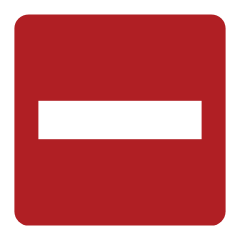
25. A driver hunting for an on-ramp meets this sign at the mouth of the pavement ahead. What is the correct action?
Show answer
Answer C: Keep out of that roadway and look for the proper approach elsewhere
The restriction is absolute and does not depend on how much traffic is present, so the driver has to reach the highway by an approach built for entering vehicles.