
New Mexico MVD Permit Practice Test 36
- Questions25
- Correct to pass18
- Passing score72%
- Minimum age15 years
-
1. What must a New Mexico driver pay to reinstate after a suspension for writing a bad check to the MVD?
Show answer
Answer C: A $20 returned-check fee plus a $25 license or $30 registration reinstatement fee
New Mexico's bad-check suspension requires a $20 returned-check fee plus a reinstatement fee of $25 for a driver's license or $30 for vehicle registration.
-
2. You are stopped at a T-intersection and a driver on the through road is signaling a right turn into your road. What is the safe assumption?
Show answer
Answer B: The driver may not actually turn, so wait until the vehicle slows and starts turning
A blinking signal may have been left on by mistake or may be for the next street, so wait until the vehicle actually slows and turns.
-
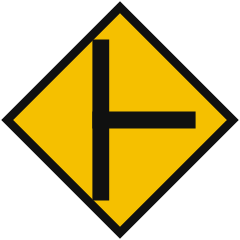
3. Approaching the point this sign refers to, which hazard is most likely?
Show answer
Answer A: A vehicle pulling out from the entering road into the driver's path
The main risk is a driver on the entering road who misjudges the gap and pulls out, so covering the brake and being ready to slow is the sensible response.
-
4. You are driving down a parking aisle and reach the main lane that runs along the front of the store. What is the usual rule?
Show answer
Answer C: The main through lane has the right of way over the vehicles leaving the aisles
In a parking lot the wide lane that runs across the ends of the aisles works like a through road, and drivers leaving an aisle yield to it.
-
5. Trees block the view along the tracks as a driver approaches this sign. What approach speed is correct?

Show answer
Answer B: Slow enough to stop before the nearest rail once a train comes into view
Where the view along the track is obstructed, the only safe speed is one that still leaves stopping distance after a train first becomes visible.
-
6. How does higher speed affect the outcome of a crash?
Show answer
Answer A: It leaves less time to react and greatly increases the force of impact
Speed shortens the time available to avoid a hazard and raises the energy released in an impact, so both the likelihood and the severity of a crash increase.
-
7. You are backing straight down a driveway while looking over your right shoulder. Where should your left hand be?
Show answer
Answer C: At the top of the steering wheel, holding it with a firm grip
With one hand at the top of the wheel you can hold a straight course and make small corrections while your body is turned to look behind.
-
8. Rain is falling and the outside temperature reads close to 32 degrees Fahrenheit. Why is that dangerous?
Show answer
Answer A: The rain can freeze on contact and glaze the road with ice
Near freezing, rain landing on cold pavement can turn to a glaze of ice almost at once, so a road that looks merely wet may have no grip at all.
-
9. What vision standard must a New Mexico applicant meet on the required eye exam?
Show answer
Answer A: 20/40 or better in at least one eye
New Mexico requires a vision screening showing 20/40 or better in at least one eye for both new and renewal applicants.
-
10. The engine dies at speed and the dashboard lights go out on a dark road. What should you do?
Show answer
Answer C: Hold the wheel firmly, steer over to the shoulder and use the hazard lights
Never switch the ignition to lock, because the steering can lock; steer to the shoulder and warn traffic with the hazard lights.
-
11. Two vehicles meet on a steep, narrow mountain road with no room to pass. Which driver should back up?
Show answer
Answer C: The driver heading downhill, who has more control while reversing
On a narrow mountain road the vehicle facing downhill yields, because backing uphill gives better control than reversing down a grade.
-
12. Another driver takes a right of way that was legally yours. What should you do?
Show answer
Answer A: Give way to the other driver and avoid the crash, whatever the law says
Right of way is something you give, not something you take, and being in the right is no protection in a collision.
-
13. What is the proper use of the horn?
Show answer
Answer C: To give a brief warning when another road user may not have seen you
The horn is a warning device meant to alert someone to your presence when a collision is possible, and using it in anger tends to escalate conflict rather than prevent crashes.
-
14. A large panel mounted on a trailer at the roadside displays a flashing arrow pointing left. What does it tell you?
Show answer
Answer B: Move into the lane to your left
An arrow panel directs traffic out of a closed lane, so the arrow shows the direction you must move rather than the shape of the road ahead.
-
15. Where is a strong crosswind most likely to hit you suddenly?
Show answer
Answer D: Coming out of a tunnel or a cut onto an open bridge
Gusts arrive the moment you leave shelter, which is why bridge approaches and the ends of cuts and tunnels catch drivers out.
-
16. A high truck ahead of you hides the traffic signal as you approach the intersection. What should you do?
Show answer
Answer A: Drop back so you can see the signal and the truck's brake lights
Extra following distance restores your view of the signal, so you are reacting to the light yourself rather than copying the truck driver.
-
17. The vehicle in front of you has stopped and is waiting to turn left, and there is a paved shoulder to the right. May you use it to get by?
Show answer
Answer D: No, in most states a pass may not be made by leaving the paved travel lanes
Passing on the right is normally lawful only inside the marked travel lanes, and most states prohibit driving onto the shoulder to get around a turning vehicle; the few states that allow it attach strict conditions.
-
18. When does a New Mexico four-year driver license actually expire?
Show answer
Answer B: 30 days after the licensee's birthday in the fourth year
A four-year New Mexico license does not expire on its issue-date anniversary; it expires 30 days after the licensee's birthday in the fourth year.
-
19. You get into a heated argument with a passenger while driving. What should you do?
Show answer
Answer D: End the discussion or pull over to finish it
Anger narrows attention and encourages risk, and a conversation you cannot let go of is a passenger you should be parked to talk with.
-
20. Your vehicle has a backup camera. What is the right way to use it?
Show answer
Answer C: Use it as an aid, but still turn and look behind you
A camera has a limited field of view and can be dirty or wet, so it supplements looking over your shoulder and using the mirrors rather than replacing them.
-
21. What does a blood alcohol concentration of 0.08 mean for the driver of a car?
Show answer
Answer B: It is the level almost every state treats as legally intoxicated
In almost every state a driver at 0.08 or above is legally intoxicated whatever the driver seems like, but impairment starts well before that level is reached.
-
22. You turn from asphalt onto a loose gravel road. What should you do about your speed?
Show answer
Answer D: Lower it, since grip is reduced and stopping takes longer
Loose gravel gives far less grip than pavement, so speed must come down for both steering and stopping.
-
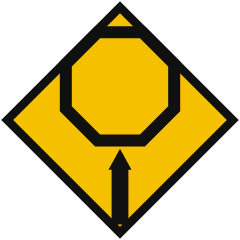
23. What is the driver expected to do after passing this sign?
Show answer
Answer A: Begin slowing so that a complete stop can be made at the intersection ahead
It is used where the control at the intersection stays hidden until late, so braking should begin here rather than at the stop line.
-
24. A truck passes you in heavy rain and its spray blanks out your windshield. What should you do?
Show answer
Answer B: Hold the wheel steady, ease off slightly and let the wipers clear it
The blackout lasts a second or two. Keeping your line and easing off is far safer than braking hard or steering blind toward the shoulder.
-
25. You began a turn from the wrong lane and are already inside the intersection. What should you not do?
Show answer
Answer A: Reverse in order to get back into the correct lane
Backing up in an intersection puts you into the path of traffic that cannot expect it; finish the movement and fix your position afterwards.