
New Mexico MVD Permit Practice Test 8
- Questions25
- Correct to pass18
- Passing score72%
- Minimum age15 years
-
1. A freeway sign reads BUSES ONLY ON SHOULDER 6 AM TO 9 AM. Who may drive on the shoulder then?
Show answer
Answer A: Only the vehicles named on the sign, during the hours shown
Shoulder running is granted by the sign to the class of vehicle and the hours the sign names, and it does not turn the shoulder into a general travel lane.
-
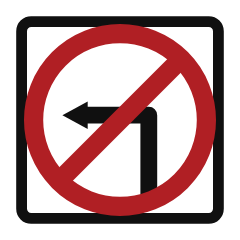
2. No plaque stating days or hours accompanies this sign at the intersection. When does the restriction apply?
Show answer
Answer D: At all times, since nothing limits it to particular periods
A regulatory restriction runs continuously unless a supplemental plaque states the days or hours during which it applies.
-
3. Warning signs such as stop ahead, yield ahead and signal ahead are installed mainly where
Show answer
Answer B: the traffic control device cannot be seen from far enough away
These advance warning signs are used when a crest, curve or obstruction keeps the stop sign, yield sign or signal from coming into view in time for a driver to react.
-
4. The car ahead drifts across the lane line and back again several times. What should you do?
Show answer
Answer C: Assume that the driver is distracted or impaired, and keep well back
Drifting is a classic sign of a distracted, drowsy or impaired driver, and distance is your protection from all three.
-
5. Is it a good idea to shift into neutral and coast down a long hill to save fuel?
Show answer
Answer B: No, you lose engine braking and some control of the vehicle
In neutral the engine cannot help slow the vehicle, so the brakes do all the work and can overheat. Stay in gear so the drivetrain helps hold your speed.
-
6. A driver is following you far too closely and you have a turn coming up. How should you slow down for it?
Show answer
Answer B: Signal early and slow gradually well before the turn
Early signals and gentle braking give a tailgater the time and distance they have failed to leave for themselves.
-
7. You are crossing a divided highway with a wide median. How should you treat the two roadways?
Show answer
Answer D: As two intersections, waiting in the median only when your vehicle fits
Each roadway of a divided highway is a separate intersection, and you should wait in the median only if it is long enough to hold your vehicle clear of both roadways.
-
8. You are stopped in slow traffic and a motorcycle comes up between the lanes. What should you do?
Show answer
Answer D: Hold your position and avoid any sudden lane change
The danger to a rider between lanes comes from a vehicle moving sideways without warning, so staying predictable is what protects them.
-
9. Who is New Mexico's Ignition Interlock License NOT available to, even though they were revoked for a DWI-related reason?
Show answer
Answer A: Someone convicted of homicide by vehicle or great bodily injury by vehicle while intoxicated
New Mexico's Ignition Interlock License is available to most drivers revoked or denied for DWI, but not to someone convicted of homicide by vehicle or great bodily injury by vehicle while intoxicated.
-
10. You are in the acceleration lane and the gap you were aiming for is now beside you. What is the best adjustment?
Show answer
Answer A: Change your speed a little to line up with a gap, then merge smoothly
The acceleration lane is for matching both the speed and the position of a gap, and small speed adjustments are what line the two up.
-
11. As a center two-way left-turn lane reaches an intersection, the markings change into a single left-turn lane. What does that mean for you?
Show answer
Answer D: From that point it serves one direction only, so use it just to turn left
Where the shared lane becomes a marked turn bay it belongs to one direction of travel, and only vehicles making that left turn may occupy it.
-
12. You carry reflective warning triangles in your car. How should they be used after a breakdown?
Show answer
Answer B: Set out behind the vehicle, far enough back to warn traffic before it arrives
A warning device works only if drivers see it in time to react, so it is placed well back along the road they are traveling.
-
13. A black on white regulatory sign at an intersection reads NO TURNS. What may a driver do there?
Show answer
Answer B: Only continue straight through the intersection
The NO TURNS sign bans turns in every direction at that intersection, so the only lawful movement from that approach is straight through.
-
14. You are about to make a three-point turn on a narrow two-way street. What is the first step?
Show answer
Answer B: Pull close to the right edge, signal left and check traffic both ways
A three-point turn starts from a stop at the right edge with a left signal, and you only move once you have checked that both directions are clear.
-
15. What makes up the total distance needed to bring a vehicle to a stop?
Show answer
Answer A: The distance covered while you perceive the hazard, the distance covered while you react, and the braking distance
Total stopping distance combines the ground covered while you notice the hazard, the ground covered while you move your foot to the brake, and the ground covered while the brakes slow the vehicle.
-
16. Why is a wet road at night harder to read than the same road in daylight?
Show answer
Answer A: The wet surface reflects light away and swallows the lane markings
A film of water sends your headlight beam onward instead of back to you, so lines, edges and people in dark clothing almost disappear.
-
17. An arrow panel in a work zone shows four flashing lamps in caution mode instead of an arrow. What does that display mean?
Show answer
Answer A: Warning only, so pass the work area with caution in your current lane
Caution mode gives a general warning without directing a lane change, so drivers stay alert and pass the activity with care.
-
18. What does a broken line indicate, whatever color it is painted?
Show answer
Answer C: That crossing it is permitted
A broken line always describes a permissive condition, and the color then tells the driver whether the traffic beyond it runs the same way or the opposite way.
-
19. Red pavement markings are used on a roadway to show that
Show answer
Answer A: it must not be entered from that direction
Red markings identify a roadway that is not to be entered or used, and they also mark the pavement of truck escape ramps.
-
20. You are calling 911 to report a crash. Which information matters most?
Show answer
Answer C: The exact location, how many people are hurt and any hazard such as fire
Dispatchers need to know where to send help, how much help to send, and what dangers the crews will meet on arrival.
-
21. Which of these places should never be used to turn your vehicle around?
Show answer
Answer C: The driveway of a fire station or the roadway in front of it
Turning around in or in front of a fire station driveway can block emergency vehicles leaving, and most states prohibit it.
-
22. You are leaving a private driveway and entering a public street. What are you required to do?
Show answer
Answer B: Stop and yield to traffic on the street and to pedestrians on the sidewalk
A driver entering a roadway from a driveway, alley or private road must stop and yield to traffic on the roadway and to pedestrians on the sidewalk being crossed.
-
23. A vehicle coming toward you has drifted into your lane. What should you do?
Show answer
Answer D: Slow down, sound the horn, flash your lights and steer to the right if possible
Moving right gives the other driver space to recover and keeps you out of the lane they are most likely to return to. Braking reduces the force of any impact.
-
24. You are about to pull out of a driveway when someone on the sidewalk is walking toward it. What should you do?
Show answer
Answer D: Wait, because traffic on the sidewalk has the right-of-way
A vehicle entering the roadway from a driveway yields to people on the sidewalk as well as to traffic on the street.
-
25. A curb lane is marked BUS ONLY 7 AM TO 9 AM. What may the driver of a car do?
Show answer
Answer A: Use the lane outside those hours
A part-time bus lane is reserved only during the posted period, and outside it the lane serves general traffic like any other.