
New Mexico MVD Motorcycle Practice Test 19
- Questions25
- Correct to pass18
- Passing score72%
- Minimum age13 years
-
1. How long is the administrative license revocation for a New Mexico adult's first DWI offense under the Implied Consent process?
Show answer
Answer D: Six months
New Mexico's administrative Implied Consent revocation runs six months for an adult's first DWI offense, shorter than the one-year period that applies to a refusal or a later offense.
-
2. How should braking and swerving be combined?
Show answer
Answer C: Brake before or after the swerve, never during it
Traction can be spent on turning or on braking, and asking for both at once during a swerve is very likely to cause a skid.
-
3. Why is the staggered formation abandoned in a curve?
Show answer
Answer D: Because each rider needs the full width of the lane to choose a line through the curve
In a curve every rider must be free to use the whole lane to set up an entry and an exit line, which is impossible while holding a fixed side position.
-
4. How can a rider check the action of the front suspension while the motorcycle is stationary?
Show answer
Answer D: Hold the front brake on and push down on the bars to feel the forks move and return
Compressing the forks against the front brake shows whether they move smoothly and return without binding, sticking or making noise.
-
5. A square sign with a red field, a wide white horizontal bar and the words DO NOT ENTER tells a driver that
Show answer
Answer B: the roadway ahead must not be entered from that point
The do not enter sign is posted at the end of a one-way roadway or ramp to keep traffic from driving into it against the flow.
-
6. You are starting from a stop on a snowy, icy street and the drive wheels begin to spin. What should you do?
Show answer
Answer C: Ease off the accelerator and start again more gently
Spinning tires polish the surface and dig in. Very gentle pressure on the accelerator, and a higher gear if you have one, gives the tires the best chance to grip.
-
7. What passenger rule applies to a New Mexico rider whose first license was issued before age 18?
Show answer
Answer C: No passenger may be carried on the motorcycle
An initial licensee, meaning a first-time license holder licensed under 18, may not carry any passenger while riding a motorcycle.
-
8. How much clear road do driver manuals say you need before starting a pass at highway speed on a two-lane road?
Show answer
Answer C: Enough to complete the pass and return, roughly ten to twelve seconds of travel
At highway speed the whole maneuver of pulling out, overtaking and returning takes roughly ten to twelve seconds, and every foot of that has to be visible before you start.
-
9. On traffic control devices, the color green shows direction to a destination and also shows
Show answer
Answer C: that a movement is permitted
Green carries two assignments: guidance toward destinations, and the idea that the movement shown is allowed, as on a green arrow.
-
10. When should speed be adjusted for a curve?
Show answer
Answer B: Before entering the curve
Slowing before the curve lets the rider hold a steady or slightly increasing throttle through it, which settles the suspension and keeps traction predictable.
-
11. The circular sign shape is reserved for which warning?
Show answer
Answer C: Advance warning of a highway-rail grade crossing
A round yellow sign with a black X and the letters RR is the grade crossing advance warning sign, and the circular outline is used for no other message.
-
12. When should headlights be switched on besides during the hours of darkness?
Show answer
Answer C: Whenever rain, fog, snow or dust makes it harder to see or to be seen
Headlights are as much about being seen as about seeing, so they go on whenever visibility drops.
-
13. A funeral procession with headlights on is crossing an intersection when your light turns green. What should you do?
Show answer
Answer A: Wait and let the whole procession go through
Most states let a funeral procession stay together once the lead vehicle has lawfully entered an intersection, and in every state you must yield to vehicles already in the intersection, so wait until the line has passed.
-
14. A wide solid white line separates the through lanes from an exit lane. What does it tell drivers?
Show answer
Answer B: The choice of lane should already have been made
A channelizing line marks where the paths separate and crossing it is discouraged or prohibited, so the lane change has to happen upstream.
-
15. A rider signals that they need to stop, although nobody else in the group wants a break. What should happen?
Show answer
Answer A: The group stops, because a rider who needs a break should get one
A rider who is tired, cold or uncomfortable is a hazard to the whole group, and stopping costs far less than the mistake that follows.
-
16. How much more energy must your brakes absorb if you double your speed?
Show answer
Answer D: About four times as much, since energy rises with the square of speed
Kinetic energy grows with the square of speed, so twice the speed means about four times the energy and a far longer braking distance.
-
17. Why does a rider on an unfaired motorcycle tire faster on a long highway ride than a driver would?
Show answer
Answer A: Constant wind pressure and noise drain energy hour after hour
Fighting wind pressure and enduring wind noise for hours is physically tiring, which is why wind protection and regular breaks matter on long rides.
-
18. Which quality matters most in a face shield?
Show answer
Answer B: It resists penetration and is free of deep scratches
A shield has to stop objects thrown up from the road and stay clear enough for undistorted vision, and it needs some airflow so that it does not fog.
-
19. A pedestrian using a white cane or walking with a guide dog starts to cross the street ahead of you. What must you do?
Show answer
Answer A: Yield and stay stopped until the person has finished crossing
A white cane or guide dog identifies a pedestrian who may not be able to see your vehicle, so you must yield and wait rather than maneuver around the person. The horn can confuse the pedestrian or the dog.
-
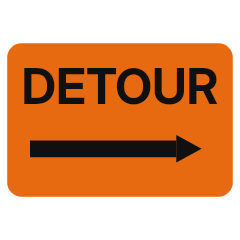
20. Once a driver has joined the route this sign begins, how is the rest of the way marked?
Show answer
Answer B: By further markers of the same kind at each turn, until the original road is rejoined
The alternate route is signed continuously, with a marker at every turn, so a driver with no local knowledge can follow it back to the original road.
-
21. A yellow sign ahead of an underpass reads LOW CLEARANCE 12 FT 6 IN. What does the figure tell you?
Show answer
Answer B: The greatest height that can pass beneath the structure
The figure is the actual clearance available, so a vehicle taller than that must leave the road and take a marked alternative route.
-
22. The driver of a slow farm vehicle moves partly onto the shoulder and waves you past. Who is responsible for the pass?
Show answer
Answer A: You are, so pass only if you can see that the road is clear
A courtesy wave is not a traffic control, and the driver who changes lanes is the one answerable for the maneuver.
-
23. Why can a mild afternoon still chill a rider dangerously on the highway?
Show answer
Answer B: Riding speed creates a wind chill well below the air temperature
Air moving over the body at highway speed strips heat far faster than still air, so a comfortable temperature at a standstill can cause serious chilling in an hour of riding.
-
24. What is a microsleep?
Show answer
Answer D: A few seconds of sleep, sometimes with the eyes open
A microsleep is an involuntary lapse of a few seconds during which the driver is asleep and the vehicle travels blind, often without the driver knowing.
-
25. Which clue best warns a rider that the door of a parked car is about to open?
Show answer
Answer B: Someone visible in the seat, or exhaust showing at the tailpipe
Occupied cars are the ones that open doors, so scan through rear windows and mirrors and look for exhaust or wheels turning as you approach.