
New Mexico MVD Motorcycle Practice Test 50
- Questions25
- Correct to pass18
- Passing score72%
- Minimum age13 years
-
1. For a New Mexico applicant under 18, what does the Motorcycle Safety Foundation Basic RiderCourse certificate waive?
Show answer
Answer A: The road test requirement only
For these young applicants the course certificate waives the riding test, but the written motorcycle knowledge test must still be passed.
-
2. You have stopped on an uphill grade close behind a large truck at a traffic signal. What is the risk?
Show answer
Answer B: The truck may roll back into you when it starts to move
Heavy vehicles can roll backward a short distance when the driver moves from the brake to the accelerator on a hill. Leave extra room when stopped behind a truck on a grade.
-
3. A steady green arrow pointing left is displayed for your turning lane. What does it tell you?
Show answer
Answer D: The turn is protected because conflicting traffic is being held
A steady green arrow gives a protected movement in the direction shown, although you still yield to pedestrians and to any vehicle already inside the intersection.
-
4. How does the supervising licensed driver accompany a New Mexico motorcycle instructional permit holder, as opposed to a car permit holder?
Show answer
Answer B: By riding behind the learner instead of sitting beside them
For a car, the supervising licensed driver sits in the right front seat, but on a motorcycle the licensed driver follows the learner instead.
-
5. How does the distance needed to stop change when a rider doubles speed?
Show answer
Answer D: It grows to roughly four times the original distance
Braking distance rises with the square of speed, so twice the speed needs roughly four times the distance in which to stop.
-
6. Why does this warning matter more on a motorcycle than in a car?
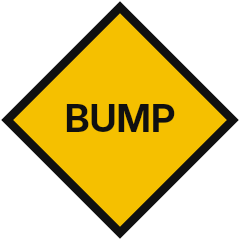
Show answer
Answer B: Because a sudden jolt can unsettle a two-wheeled machine and the rider can lose control
A jolt can push a motorcycle off line or lift a wheel, so a rider slows early, comes slightly off the seat and keeps a relaxed but firm hold on the handlebars.
-
7. In most states, when are headlights required apart from times of poor visibility?
Show answer
Answer A: From about half an hour after sunset to half an hour before sunrise
Most states require lights from about half an hour after sunset until about half an hour before sunrise, and some simply say sunset to sunrise; lights are also required whenever visibility is poor.
-
8. A sign at the intersection prohibits U-turns, but the opening looks wide and clear. What may you do?
Show answer
Answer B: Obey the sign and turn around somewhere else
A prohibition applies whatever the traffic looks like at that moment, usually because of sight distance or conflicts you cannot see from the lane.
-
9. What do two solid yellow lines down the middle of a two-way road mean?
Show answer
Answer D: Passing is prohibited for traffic in both directions
A double solid yellow line marks a two-direction no-passing zone, so neither direction may cross it to overtake another vehicle.
-
10. Where should a rider with a disabled motorcycle try to stop?
Show answer
Answer D: Well clear of the traffic lanes, off the shoulder where there is room
Getting completely away from moving traffic protects the stopped rider and anyone helping, and a shoulder alone is not a safe place to work on a machine.
-
11. The engine has warmed up and idles smoothly. What should be done with the choke?
Show answer
Answer C: Turn it off
A warm engine running on a rich mixture wastes fuel, runs poorly and can foul the spark plugs, so the choke is closed once it is no longer needed.
-
12. How does riding in a formation change your responsibility for your own space cushion?
Show answer
Answer C: It does not change it, because each rider still manages their own space and decisions
A formation organizes the group, but every rider remains responsible for their own following distance, escape paths and riding decisions.
-
13. Is dictating a message by voice a safe alternative to typing one?
Show answer
Answer C: No, it still takes attention from driving
Composing and checking a spoken message loads the mind and usually pulls the eyes to the screen anyway, so research finds it no safer than other phone use.
-
14. On a clear day with light traffic, a driver stays far below the maximum this sign sets. What can that cause?
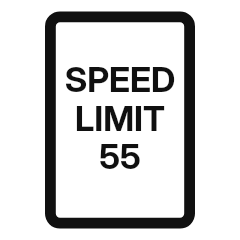
Show answer
Answer B: Obstruction of the normal flow of traffic, which is prohibited in itself
Driving so slowly that other traffic is impeded is an offense in its own right when nothing about safety, weather or the road calls for it.
-
15. Why do safety agencies put head protection first among riding gear?
Show answer
Answer A: Because head injuries are the leading cause of death in motorcycle crashes
Head injury is the most common cause of death in motorcycle crashes, which is why a certified helmet is the single most important piece of gear.
-
16. What is a rider looking for when inspecting the control cables?
Show answer
Answer A: Kinks, fraying and stiff or notchy movement
A frayed strand or a kinked outer will eventually jam or snap, which can leave a rider without a clutch, a throttle or a front brake.
-
17. A regulatory sign reads TURN ON HEADLIGHTS NEXT 15 MILES. What does it require?
Show answer
Answer C: Low beam headlights on for that stretch, day or night
Such a section is signed where a road is hard to see along, and the requirement is to run headlights, not just daytime running lamps, through the whole stretch even in bright daylight.
-
18. A driver ahead brakes for no reason you can see, again and again. What should you do?
Show answer
Answer B: Increase your following distance and be ready for yet another stop
Unexplained braking tells you the driver is unsure or distracted, so the safe answer is more room, not less.
-
19. You are behind a snow plow working on a highway. What is the correct way to drive?
Show answer
Answer C: Stay well back and do not try to pass it
A plow throws snow, runs wider than its body and works on the poor surface ahead of it, so the cleared road behind it is the safest place to be.
-
20. You are leaving a private driveway and entering a public street. What are you required to do?
Show answer
Answer B: Stop and yield to traffic on the street and to pedestrians on the sidewalk
A driver entering a roadway from a driveway, alley or private road must stop and yield to traffic on the roadway and to pedestrians on the sidewalk being crossed.
-
21. Is it a good idea to shift into neutral and coast down a long hill to save fuel?
Show answer
Answer B: No, you lose engine braking and some control of the vehicle
In neutral the engine cannot help slow the vehicle, so the brakes do all the work and can overheat. Stay in gear so the drivetrain helps hold your speed.
-
22. Your loaded vehicle weighs more than the figure shown on a posted weight limit sign. What must you do?
Show answer
Answer D: Find another route, because crossing is not permitted
A posted weight limit is a legal maximum, not advice, so an overweight vehicle has to take a different route.
-
23. How does the crown of a road affect a turn made on it?
Show answer
Answer C: Turning toward the low side leaves less ground clearance for leaning
Leaning down the slope of the crown adds the slope to the lean angle, so the footrests and other parts reach the pavement sooner than they otherwise would.
-
24. Why should gloves and jacket sleeves overlap?
Show answer
Answer A: So no gap of bare skin is left at the wrist in a slide or the cold
The wrist is easy to leave exposed, and a gap there lets in cold air and takes the full force of a slide, so gauntlets or elastic cuffs should close the gap.
-
25. Trees block the view along the tracks as a driver approaches this sign. What approach speed is correct?

Show answer
Answer B: Slow enough to stop before the nearest rail once a train comes into view
Where the view along the track is obstructed, the only safe speed is one that still leaves stopping distance after a train first becomes visible.