
New Mexico MVD Motorcycle Practice Test 8
- Questions25
- Correct to pass18
- Passing score72%
- Minimum age13 years
-
1. What should a rider look for in rain gear?
Show answer
Answer A: A riding rain suit that fits close and will not balloon or tear at speed
Rain gear designed for riding stays sealed and stays put in the airstream, while loose garments can flap, tear or interfere with the controls.
-
2. Why is a drive chain adjusted with too little slack a problem?
Show answer
Answer A: It strains the chain, the sprockets and the output shaft bearings
Suspension movement changes the distance between the sprockets, so a chain pulled tight at rest is stretched hard over bumps and wears everything it touches.
-
3. Are ordinary eyeglasses or sunglasses adequate eye protection for riding?
Show answer
Answer B: No, since they can shatter and let wind reach the eyes from the side
Everyday lenses are not made to resist impact and leave the eyes open to wind and debris, so a face shield or goggles are needed instead.
-
4. On a multi-lane street, a yield line is painted well back from an unsignalized crosswalk rather than right at it. Why?
Show answer
Answer D: So drivers in the other lanes can see the pedestrian
Setting the yield line back keeps a stopped vehicle from hiding a crossing pedestrian from drivers in the next lane, which is a common cause of these crashes.
-
5. Where should a rider keep the knees while riding?
Show answer
Answer B: Against the fuel tank
Knees held against the tank anchor the rider to the motorcycle and improve balance, which matters most in turns.
-
6. You are on a country road with no sidewalk and two people are walking toward you on your side of the shoulder. What should you do?
Show answer
Answer C: Slow down and move over to give them room
Where there is no sidewalk, people are expected to walk on the shoulder facing traffic, and drivers must slow and give them space.
-
7. Why is a motorcycle particularly hard for other drivers to judge at night?
Show answer
Answer A: Its single headlight gives no width cues for distance and speed
Drivers judge distance from the spacing between a pair of headlights, and a single lamp gives them nothing to measure, so they routinely misjudge how close and how fast a motorcycle is.
-
8. You have just driven through a deep puddle and your brakes feel weak. What should you do?
Show answer
Answer D: Drive slowly while lightly applying the brakes until they dry and work normally
Wet brakes grip poorly and may pull to one side. Gentle braking at low speed generates heat that dries the pads and discs quickly.
-
9. What does New Mexico require of someone who wants to ride a moped?
Show answer
Answer D: Any valid driver license or permit, with no motorcycle endorsement
A New Mexico moped has an automatic transmission, an engine under 50 cubic centimeters and a top speed of 30 mph, and anyone holding a valid license or permit of any class may ride one.
-
10. What is the recommended minimum following distance behind the vehicle ahead?
Show answer
Answer C: Two seconds
A two second gap is the minimum in good conditions and should be stretched to three seconds or more on slippery roads, in poor visibility or in heavy traffic.
-
11. Studies of damaged helmets show that the most frequently struck area is which part?
Show answer
Answer C: The chin and jaw area, which an open face helmet leaves uncovered
The chin and face area takes a large share of helmet impacts, which is the main safety argument for a full face helmet over an open face one.
-
12. What happens to a New Mexico driver who refuses a blood alcohol test after a lawful request?
Show answer
Answer D: The driver can lose the driver license for one year
Under the New Mexico Implied Consent Act a refusal can cost the driver the license for one year, on top of any criminal penalty.
-
13. A motorcycle in your group develops a mechanical problem on a busy highway. What is the best response?
Show answer
Answer C: Signal the group off at the next exit or wide, safe pull off area
A narrow shoulder beside fast traffic is a dangerous place to gather, so the group moves on to a spot where every machine is well clear of the roadway.
-
14. What does the Lights and Electrics step of T-CLOCS include?
Show answer
Answer A: The battery, the headlight, the brake light and the wiring
This step covers the battery and its terminals, the headlight, tail and brake lights, the turn signals, the switches, the mirrors and the wiring.
-
15. You are pulling away from a stop with a passenger for the first time. What should you expect?
Show answer
Answer D: You will need a little more throttle and a slower clutch release
The extra weight makes the motorcycle harder to get rolling, and a rushed clutch release with a passenger aboard is a common way to stall or lurch.
-
16. On a narrow residential street, why does parking tight against the curb matter so much?
Show answer
Answer C: Because fire trucks and ambulances need the width to get through
Cars parked even a foot out from the curb on both sides can narrow a street until a fire truck or ambulance cannot pass.
-
17. You come around a bend and find loose sand spread across your lane. What should you do?
Show answer
Answer D: Ease off the gas, avoid sudden braking or steering, and keep straight
Loose material acts like ball bearings under the tires; smooth inputs preserve what little grip remains, while sudden braking or steering breaks it.
-
18. A dog runs out and chases your motorcycle. What is the recommended response?
Show answer
Answer D: Downshift and approach slowly, then accelerate away as you reach the animal
Approaching slowly keeps the dog aiming at where you are now, and accelerating as you reach it leaves the animal behind without a sudden swerve.
-
19. You are waiting to enter a two-lane roundabout and traffic is circulating in both lanes. What must you do?
Show answer
Answer A: Yield to traffic in both circulating lanes before you enter
Every entry to a roundabout is a yield point, and at a two-lane roundabout that means giving way to vehicles in either circulating lane.
-
20. Which common non-prescription medicine is most likely to make a driver drowsy?
Show answer
Answer C: A cold or allergy remedy containing an antihistamine
Antihistamines in cold and allergy remedies are a leading cause of drowsiness behind the wheel, which is why the label carries a warning.
-
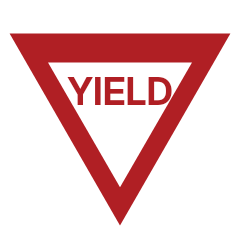
21. A driver passes this sign on an entrance ramp while merging onto a freeway. Who has priority?
Show answer
Answer B: The traffic already traveling on the freeway
The sign places the duty on the entering driver, who must adjust speed and fit into a gap without forcing through traffic to brake or swerve.
-
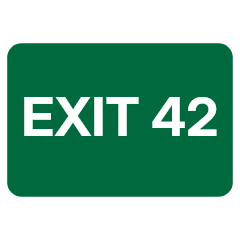
22. A driver in the left lane of a freeway realizes only when level with this sign that the ramp beside it is the one they need. What is the correct action?
Show answer
Answer A: Carry on to the next interchange and turn back from there
There is no safe way back to a ramp once it has been reached from the wrong lane, so the driver keeps going to the next interchange, where the ramps are built for that movement.
-
23. How much should you normally reduce your speed on a road covered with packed snow compared with dry conditions?
Show answer
Answer C: By about half
Packed snow roughly doubles the distance needed to stop, so a common guideline is to cut speed by about half. On ice, slow to a crawl.
-
24. When is a driver or rider most likely to need hand and arm signals instead of the vehicle turn signal lamps?
Show answer
Answer D: When the lamps have failed or cannot be seen because of glare or a load
Hand and arm signals replace or reinforce the lamps whenever the lamps do not work or cannot be seen clearly by other road users.
-
25. How does marijuana affect a driver?
Show answer
Answer C: It slows reaction time and impairs judgment of time and distance
Marijuana impairs coordination, attention and the ability to judge speed and distance. Driving while impaired by it is illegal everywhere, even where its use is legal.