
New Mexico MVD Motorcycle Practice Test 16
- Questions25
- Correct to pass18
- Passing score72%
- Minimum age13 years
-
1. By when must New Mexico hold the administrative hearing for a DWI license revocation, measured from the notice of revocation?
Show answer
Answer D: No later than 90 days
New Mexico's administrative DWI process requires the hearing to be held no later than 90 days after the notice of revocation is issued.
-
2. You enter a work zone where the top layer of pavement has been milled off, leaving a grooved surface. How should you ride?
Show answer
Answer B: Hold a relaxed grip and steady speed, and expect the tires to wander
Milled or grooved pavement makes the tires follow the ridges and the motorcycle feel unsettled, so relax on the bars, keep a constant speed and ride straight through.
-
3. A pedestrian starts to cross against a Do Not Walk signal, right in front of you. What should you do?
Show answer
Answer D: Slow or stop and let the person reach safety
Even when a pedestrian is crossing unlawfully, a driver must take reasonable care to avoid hitting that person.
-
4. When is passing another vehicle on the right generally permitted?
Show answer
Answer C: When the road has two or more lanes in your direction, or the vehicle ahead is turning left and there is room without leaving the pavement
Passing on the right is limited to situations where a lawful lane exists for it or the vehicle ahead is turning left, and it may never be done by driving onto the shoulder.
-
5. The road ahead is broken up with potholes and rough patches. What should you do?
Show answer
Answer C: Slow down, since a hole hit at speed can wreck a tire or wheel
A lower speed cuts the impact on tires, wheels and suspension and gives you time to choose a line through the rough surface.
-
6. You are parking on a one-way street where parking is allowed on both sides. What must still be true?
Show answer
Answer D: The vehicle must face the direction the traffic flows
Either curb may be used on a one-way street where signs allow it, but the vehicle must always be headed in the direction traffic moves.
-
7. What has to be done with the helmet chin strap on every ride?
Show answer
Answer B: Fastened snugly, because an unfastened helmet comes off in a crash
A helmet only protects while it stays on the head, and an unfastened or loose strap lets it leave the head in the first moments of a crash.
-
8. Traffic is backed up just past the exit you want to use at a single-lane roundabout. What should you do?
Show answer
Answer D: Wait at the yield line until you can pass through and exit
You must not enter a roundabout unless you can clear it, because stopping inside blocks every other entry.
-
9. You are driving down a parking aisle and reach the main lane that runs along the front of the store. What is the usual rule?
Show answer
Answer C: The main through lane has the right of way over the vehicles leaving the aisles
In a parking lot the wide lane that runs across the ends of the aisles works like a through road, and drivers leaving an aisle yield to it.
-
10. A driver has to stop for a train at this sign. How far back from the nearest rail should the vehicle be held?

Show answer
Answer C: No closer than roughly fifteen feet
A train and its load overhang the rails, so stopping no closer than about fifteen feet keeps the vehicle outside the space the train actually sweeps.
-
11. Why is parking next to a fire hydrant or in a marked fire lane prohibited?
Show answer
Answer D: It would delay firefighters who need immediate access to the hydrant or the building
Fire hydrants and fire lanes must remain clear at all times so emergency crews can connect hoses and reach a building without delay.
-
12. Which feature suggests that a helmet is an uncertified novelty helmet?
Show answer
Answer D: A shell less than one inch thick with no firm foam liner
Novelty helmets are typically thin and very light because they lack the stiff energy absorbing liner that a certified helmet uses to manage an impact.
-
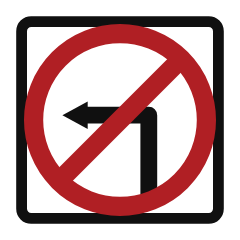
13. No plaque stating days or hours accompanies this sign at the intersection. When does the restriction apply?
Show answer
Answer D: At all times, since nothing limits it to particular periods
A regulatory restriction runs continuously unless a supplemental plaque states the days or hours during which it applies.
-
14. Your exit from a three-lane highway is about a mile ahead on the right, and you are in the left lane. What should you do?
Show answer
Answer B: Start moving right now, one lane at a time
Plan ahead and change lanes one at a time well before the exit, so you never have to cut across several lanes at the gore.
-
15. You find that the road surface has turned to sheet ice. What speed is appropriate?
Show answer
Answer A: A crawl, slow enough that you could stop without braking hard
Ice can cut grip to a fraction of normal, so stopping takes many times the usual distance and only a crawl leaves any margin.
-
16. A vehicle in front of you has already begun turning left into a driveway when the gap you were waiting for opens up. What should you do?
Show answer
Answer B: Wait and let that driver finish the turn
A vehicle that has lawfully started a maneuver keeps the right of way until it is finished.
-
17. A city transit bus ahead of you has stopped at the curb with its passenger door open. What does the law require of you?
Show answer
Answer D: Nothing special, but pass slowly and watch for people
The mandatory stop applies to a school bus showing red flashing lights, not to a transit bus, though a careful driver still slows for crossing passengers.
-
18. A yellow diamond shows an arrow bent into a series of reversing turns. What does it warn about?
Show answer
Answer A: Three or more changes of direction close together
The winding road sign replaces a string of separate curve signs where several bends follow one another with only short straights between them.
-
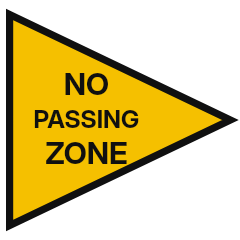
19. A driver is thinking about overtaking a slower vehicle and sees this sign a short distance ahead. What does it mean for that pass?
Show answer
Answer B: The pass must be finished before the restricted section begins
The sign marks the start of a section where passing is prohibited, so a driver may not be on the left side of the road beyond it; any pass has to be completed before that point or not started at all.
-
20. Which clue suggests that a car waiting at a side street is about to pull out in front of you?
Show answer
Answer B: The front wheels are turned and the car is creeping forward
Turned wheels and a slow creep forward are the strongest signs that a driver is about to move, so cover the brakes and be ready to change your lane position.
-
21. A steady red arrow is displayed for your left-turn lane at a two-way intersection. What must you do?
Show answer
Answer C: Stop and remain stopped until an indication permits the turn
A steady red arrow prohibits the movement it points to, so the driver stops and waits for a green arrow, a flashing yellow arrow or another indication that permits the turn.
-
22. What should a rider understand about the horn on a motorcycle?
Show answer
Answer A: It is often weak and may not be heard, so it never replaces an escape route
A small horn competes with a closed car, a radio and traffic noise, so a rider plans a way out instead of trusting the horn to be heard.
-
23. You are riding up an entrance ramp to merge onto a freeway. What should you do?
Show answer
Answer D: Build up to traffic speed on the ramp, then signal and check the blind spot
Matching the speed of freeway traffic before merging avoids forcing others to brake, and a head check covers the area the mirrors do not show.
-
24. You want to pass on a two-lane road where several people are walking on the narrow shoulder ahead. What should you consider?
Show answer
Answer D: There is no escape room if the pass goes wrong, so wait for a better place
A pass depends on having somewhere to go if it goes wrong, and a shoulder occupied by pedestrians removes that option for both vehicles.
-
25. Oil is visible running down the front fork tubes. What does that mean?
Show answer
Answer C: A fork seal has failed and the suspension needs repair
Fork oil escaping past a seal means the front suspension is losing its damping, and the oil can also reach the front brake and ruin its grip.