
New Mexico MVD Motorcycle Practice Test 17
- Questions25
- Correct to pass18
- Passing score72%
- Minimum age13 years
-
1. You are entering a freeway using an on-ramp with an acceleration lane. What is the correct technique?
Show answer
Answer C: Use the acceleration lane to reach the speed of traffic, then merge into a gap while yielding to traffic already on the freeway
The acceleration lane exists so you can match the speed of freeway traffic before merging, and drivers already on the freeway have the right-of-way.
-
2. Apart from a crash, when do helmet makers generally advise replacing a helmet?
Show answer
Answer A: After several years of use, as the liner and materials age
Liners, glues and straps degrade with sweat, sunlight and time, so manufacturers commonly recommend replacing a helmet after several years even if it looks fine.
-
3. A sign on a long descent points to a RUNAWAY TRUCK RAMP a mile ahead. What is that ramp for?
Show answer
Answer C: Stopping a vehicle whose brakes have failed
An escape ramp climbs into deep gravel or sand to bring a vehicle with failed brakes to a halt, so no one should stop or park in it.
-
4. What do the letters in the SEE riding strategy stand for?
Show answer
Answer B: Search, Evaluate, Execute
Riders search for hazards, evaluate how those hazards could interact, and execute a plan by adjusting speed, position or communication.
-
5. The rear tire loses air suddenly while you are riding. Which symptom should you expect and how should you respond?
Show answer
Answer D: The rear sways or feels heavy, so ease off and slow with the front brake
A rear flat makes the back of the motorcycle wallow or sway, so hold your line, close the throttle gently and slow mainly with the brake on the wheel that still has air.
-
6. You are turning left out of a driveway onto a busy two-way street. What must you do?
Show answer
Answer D: Wait for a gap in both directions before you start to move
The turn crosses one direction of traffic and joins the other, so you need a gap in both before leaving the driveway rather than stopping across a lane.
-
7. Four vehicles reach a four-way stop from all four directions at the same instant. How is the deadlock resolved?
Show answer
Answer C: Each driver yields to the vehicle on the right and they go one by one
Yielding to the right applies to every driver, so the group untangles itself as drivers take turns rather than moving together.
-
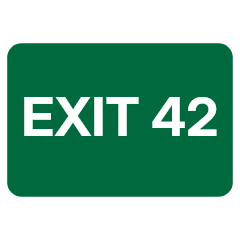
8. Where is signing of this kind normally placed along a freeway?
Show answer
Answer D: Ahead of the interchange and again at the exit, so a driver can reach the correct lane in time
Guide information for an interchange is repeated on the approach and at the ramp, because a driver who learns about the exit only at the last moment has no room left for a safe lane change.
-
9. You reach a stretch of road covered by moving flood water of unknown depth. What is the correct decision?
Show answer
Answer D: Turn around and take another route
About a foot of moving water is enough to carry away most cars, and the roadbed under the water may already be washed out, so the only safe choice is to turn around.
-
10. A sign showing a figure with an outstretched thumb inside a red circle with a slash means that
Show answer
Answer B: soliciting a ride is prohibited there
The no hitchhiking sign bars standing beside the road to solicit a ride, and it is common along freeway ramps and shoulders.
-
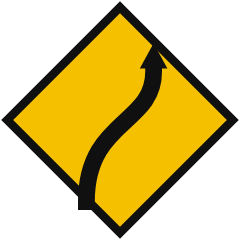
11. A driver holds a steady highway speed into the section this sign warns about. What is the most likely result?
Show answer
Answer B: The vehicle runs wide toward the outside and can cross into another lane or leave the pavement
Holding speed into a change of alignment asks the tires for more side grip than they can supply, so the vehicle runs wide and the driver is left with less room to correct.
-
12. You see brake lights several vehicles ahead of you in your lane. What is the best first step?
Show answer
Answer C: Ease off the gas and cover the brake pedal
Reacting to the trouble several vehicles ahead, rather than waiting for the car in front, cuts your reaction time and warns the driver behind you.
-
13. Should a rider change lanes while passing through an intersection?
Show answer
Answer A: No, the lane change should be completed before or after the intersection
Drivers entering and turning at an intersection are watching lanes rather than a machine moving between them, and lane markings are usually broken there.
-
14. You will leave your vehicle for several hours after dark. Where is the best place to park it?
Show answer
Answer D: In a well-lit spot with people and cameras nearby
Light, passing people and cameras all discourage theft and make your own return to the vehicle safer.
-
15. A disabled vehicle is blocking your lane on a two-lane road with a single solid yellow line on your side. What should you do?
Show answer
Answer C: Wait until the oncoming lane is clear, then go around carefully
The solid line prohibits overtaking a moving vehicle, but in most states a driver may go around an obstruction such as a disabled vehicle once the oncoming lane is clear and the move can be made safely.
-
16. A driver slows to walking pace at this sign, never stops rolling and eases into the intersection. How is that treated?

Show answer
Answer B: It is a violation, because the vehicle never came to a complete halt
What is required is a full halt with the wheels no longer turning, so slowing down, however carefully, does not satisfy it.
-
17. Why do experienced riders cover the clutch lever and the brake lever in heavy traffic?
Show answer
Answer B: It shortens the time needed to react if they suddenly have to stop
With fingers already resting on the levers the rider skips the time it takes to reach for them, which shortens overall stopping distance.
-
18. What must a New Mexico driver show to reinstate a license once a DWI revocation period has ended?
Show answer
Answer C: Six consecutive months on an ignition interlock license with no attempt to tamper with the device
New Mexico requires six consecutive months of driving on an ignition interlock license, with no attempted tampering, before a DWI-related license can be fully reinstated.
-
19. The group has become separated and the leader wants to wait for the missing riders. Where should the leader pull in?
Show answer
Answer C: In a parking area or other space that is clear of moving traffic
Waiting somewhere off the roadway keeps the parked machines and their riders out of traffic and gives the arriving riders room to pull in safely.
-
20. With the chin strap fastened, how can you check that a helmet is the right size?
Show answer
Answer A: Try to roll it forward off your head, since a good fit will not come off
The roll off test shows whether the helmet will stay on in a crash. If it can be rolled off the front of your head with the strap done up, it is too big.
-
21. In a work zone the temporary lane lines conflict with the old lines still visible on the pavement. Which do you follow?
Show answer
Answer C: The temporary markings, which show the current traffic pattern
Temporary markings define the traffic pattern in force, and the old lines are simply the layout that no longer applies.
-
22. After turning right you see a sign showing that your lane ends a short way ahead. What should you do?
Show answer
Answer B: Signal and merge into the next lane while there is still room
Merge early and smoothly while a gap is still available, rather than running out of pavement or forcing your way in at the last moment.
-
23. How should a load be distributed between the two saddlebags?
Show answer
Answer B: Evenly, so the weight is balanced from side to side
An uneven load pulls the motorcycle toward the heavy side and makes it behave differently in left turns than in right turns.
-
24. Unless posted otherwise, what is the New Mexico speed limit in business or residential areas?
Show answer
Answer B: 30 mph
New Mexico uses 30 mph as the default in business and residential areas, a little higher than the 25 mph many states apply.
-
25. A truck ahead of you is spreading salt or grit on the road. What should you do?
Show answer
Answer B: Drop back so the material does not reach your car
Spreaders throw material backward and sideways, and following close means stone chips and a screen full of spray, so leave extra distance.